
The Council of Canadian Academies recently published Enhancing Canada’s National-Scale Research Infrastructure, an independent expert-panel assessment of how Canada can optimize its major research facilities, digital infrastructure and collaborative networks.
For research organizations interested in understanding their impact on people, one feature of the report stands out:
Talent is not treated as a secondary benefit of research infrastructure. It is built into the report’s model of how research infrastructure creates impact.
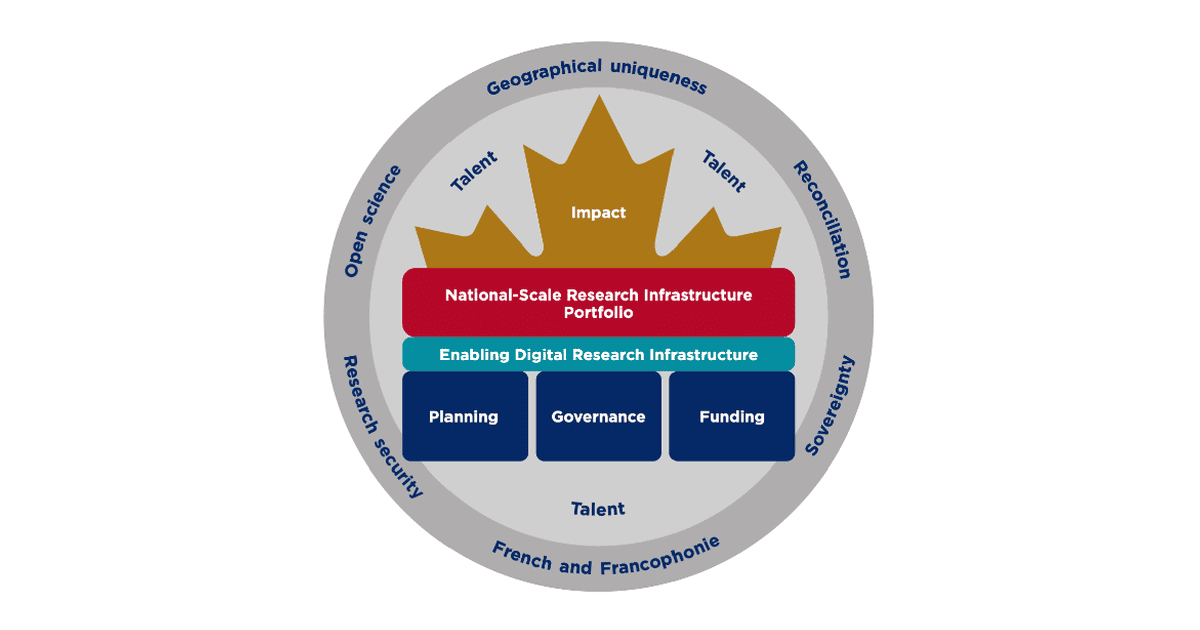
You can see that emphasis in the report’s own framework. Talent appears three times in Figure 1.2, surrounding the elements that connect research infrastructure to impact.
The report explains the relationship directly:
“Talent functions as both a critical input and output, underpinning the system’s capacity to operate and deliver impact.”
That is an important way to think about talent development. Researchers, technicians and other highly qualified people are necessary to make research infrastructure work. But development of those people is also one of the things the infrastructure produces.
Talent is built into the framework
The emphasis on talent in Figure 1.2 is not isolated.
The report describes talent as a critical input to, and an output of, national-scale research infrastructure. It emphasizes that realizing the potential of infrastructure depends on the people who design, manage, operate and use it, as well as the distinctive training opportunities these environments provide.

The report returns to talent throughout its analysis, examining the role research infrastructure plays in developing people who contribute not only to research but to the broader economy and research ecosystem.
Training is an impact, not simply an activity
That distinction becomes particularly important in the report’s discussion of performance monitoring and impact assessment.
The expert panel argues for a broader understanding of research impact, one that extends beyond traditional academic outputs to encompass scientific, social, economic, policy, innovation, training and ecosystem effects.
This matters for how research organizations evaluate themselves.
A facility can count the number of students, postdoctoral researchers or other highly qualified personnel it trained. That is useful information.
But it is primarily a measure of activity or output.
The report distinguishes performance monitoring from impact assessment. Performance monitoring tracks activities and outputs against objectives. Impact assessment looks further downstream, at the higher-level and longer-term changes associated with those activities.
Applied to talent, that suggests a different question.
Not simply:
How many people did we train?
But:
What happened to those people afterwards?
The report points toward career outcomes
The Council of Canadian Academies does not prescribe a single method for answering that question. In fact, the report warns against one-size-fits-all approaches to impact assessment.
But several sections point toward the value of examining what happens to people after their experience with a research organization.
The report observes that students working with national-scale research infrastructure gain unusual skills and experiences and can become important assets to the labour force after graduation. It also describes career destinations extending well beyond academic research into areas including data analysis, programming, finance, marketing and sales.
That turns talent impact into questions that can be measured:
- What proportion of alumni work in different sectors and industries?
- What proportion build their careers in the country or region?
- How quickly do alumni progress into management and executive positions?
- What proportion move into research-intensive and high-technology industries?
- How do their academic achievements, retention rates and career progression compare with those of a matched control group?
Those are different questions from how many people participated in a program.
They are questions about impact.
SNOLAB provides an example
The report makes this particularly concrete in its discussion of SNOLAB.
In Box 7.1, the report cites an Alumni Analyzer study comparing SNOLAB alumni with a control group. It reports differences including workforce entry after completing a PhD, careers in Ontario and elsewhere in Canada, progression into management and executive positions, and employment in high-tech and research-intensive sectors
The significance is not the individual findings alone.
It is the kind of evidence being used.
Instead of stopping at how many people SNOLAB trained, the analysis follows their careers and compares their academic achievements, retention rates and career progression with those of a matched control group.
That begins to move the evidence from training output toward talent impact.
Impact assessment should also help organizations learn
There is another important message in the report.
Impact assessment is not presented simply as something research organizations do to satisfy a reporting requirement.
The expert panel argues that iterative, ongoing impact assessment should support learning and course correction. It should help organizations understand their impacts and improve how research infrastructure is managed and optimized over time.
That changes the value of studying alumni careers.
Career evidence can help demonstrate value to funders. But it can also tell an organization something about itself.
Where does its talent go?
Where does that talent make a difference?
Which groups experience different career trajectories?
Which parts of the training environment appear to produce particularly valuable skills?
And where might the organization change what it does?
That turns impact assessment from an exercise in proving value after the fact into a source of evidence for improving future impact.
Talent deserves to be measured accordingly
The report’s framework captures the underlying idea particularly well.
Research infrastructure depends on talent. It also develops talent. And those people can carry the skills, experience and capabilities developed through research infrastructure into subsequent careers, organizations and sectors.
There is a measurement implication.
If talent development is one of the impacts research organizations are expected to create, then counting participants is only the beginning.
To understand that impact, organizations need evidence about what happens next.
That is where alumni career data can add something that traditional training metrics cannot: evidence about where talent goes, how careers develop, and how the effects of a research experience extend beyond the organization itself.
Read the full Council of Canadian Academies report: Enhancing Canada’s National-Scale Research Infrastructure.